
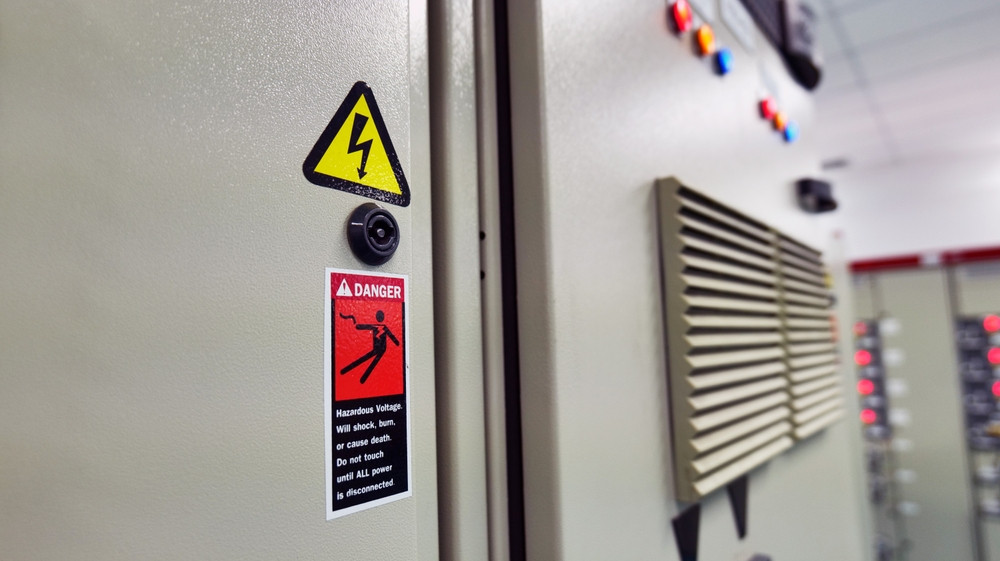
In industrial and commercial settings, electrical panel labels often get overlooked by business owners and facility managers. They’re usually considered a “useless” expense or a convenience rather than a must. Others might even be completely unaware of the code that requires them.
Yet, the simple addition of electrical panel labels can make all the difference in helping your facility avoid operational, safety, or even legal risks.
Read on to see why electrical panel labels are more than just a requirement but a necessity.
What are Electrical Panel and Circuit Labels?
Labels on an electrical panel are designed to mark the controls of each breaker or fuse of an electrical system. In other words, they tell you which circuit powers what.
Electrical panel labels are usually found at the breaker itself or within a panel directory inside or near the electrical panel door.
Labeling often goes beyond the panel in industrial or commercial facilities. Electrical system labeling also typically includes the labeling of distribution panels/subpanels, transformers, disconnect switches, emergency power systems, and more.
Why Electrical Panel Labels are Important
The intent of electrical panel labels isn’t just to act as a convenient reminder of what powers what. More importantly, it ensures decisions can be made promptly and accurately, whether by your team or first responders, during emergency events.
Here are some specific reasons why electrical panel labels are crucial in industrial and commercial buildings:
- Allows employees to quickly disable the right circuit before maintenance. This means less guesswork and a lower risk of shock for those engaging in maintenance.
- Helps ensure power can be cut off quickly in emergencies like a flood or fire
- Prevents crucial systems from accidentally being powered off by staff, when they meant to turn off a different system
- Meets electrical codes and workplace safety requirements
- Keeps everyone well-informed at all times, including new hires and third parties like first responders who aren’t familiar with your electrical system
What Does a Good Electrical Panel Label Include?
Electrical panel labeling done poorly or improperly can be just as detrimental as not having an electrical panel labeling system at all.
A good electrical panel labeling system should always include:
- Clear Identification
When labeling circuits, refrain from generic or vague descriptions. They shouldn’t be lengthy or complex. Nonetheless, they do need to be easily understood by others. Labels should identify the panel name and the associated location or piece of equipment.
- Voltage or Amperage
Voltage or amperage should be included on main distribution panels or non-residential subpanels. If your system serves multiple voltage levels, identifying those voltages can be helpful. It should also be included on panels powering vital equipment, like major machinery and safety systems.
- Special Notes
Brief, clear notes beyond identification should also be listed next to certain circuits as necessary.
For example, a facility might put a note next to a circuit alerting others that it’s a life-saving circuit, leads to emergency shut-off, or is linked with crucial manufacturing processes.
Notes like these are imperative. They can help decrease safety risks and accidental operational outages during technician troubleshooting.
Best Practices When Labeling Electrical Panels
Want to upkeep a strong electrical labeling system? Abide by these standards and practices:
#1. Stick to a Clear, Organized Format.
Well-organized and easy-to-understand electrical panel labels are written in a consistent directory-style format. They should include the circuit number, a description, voltage/phase if necessary, and the associated location or equipment.
#2. Keep Descriptions Streamlined Rather Than Technical.
Especially for larger facilities, it’s critical to stick to one-line references, rather than using complex diagrams. This keeps things simplified and easier to understand, especially when in a time crunch or facing an emergency situation.
#3. Ensure Labels are Legible.
Electrical panel labeling systems fail when the user is unable to make out what’s written on the panel or directory.
Handwritten labels are often not ideal, especially for commercial settings. They’re prone to poor legibility due to sloppy handwriting, misspellings, smudging, and fading.
Instead, consider a printed or engraved labeling system. Use durable materials that are resistant to heat, light, moisture, and cleaning chemicals. Labels should also be large enough in size, high contrast, and in a legible font.
#4. Don’t Leave Circuits or Breakers Unlabeled.
Leaving some breaks without a label can be risky, especially in a commercial or industrial facility. Unlabeled breakers can potentially lead to code and compliance issues, trial-and-error mistakes that trigger downtime, and delayed shutdowns during an emergency event.
Even unused breakers should have a label. Rather than leaving them blank, consider labeling them as “vacant” or “spare.” This will remind employees to leave those switches alone.
#5. Update Electrical Labels as Needed.
Electrical labels may need to be periodically updated. This is especially true after the improvement or renovation of tenant space, when equipment is relocated, or when circuits are added or removed.
An outdated electrical panel directory has the potential to be just as dangerous, if not more so, than a completely unlabeled system. With a label-less system, users may engage in pure trial-and-error when disabling circuits.
However, with labeled systems, users may feel fully confident in following a system’s directory, only to later realize it wasn’t adequately updated. See the harm in not regularly updating your labels?
Common Mistakes with Electrical Labeling
These are common yet easily avoidable labeling mistakes for electrical systems:
- Using vague labels/names
- Inconsistencies in labeling
- Having outdated or inaccurate directories
- Difficult-to-read labels, especially if handwritten (small or cramped text, sloppy writing, fading labels, etc.)
- Missing labels on some breakers, even unused ones
- Lengthy or complex descriptions
One error can lead to a big mistake or even failed inspections/citations.
Residential vs Commercial Labeling
Electrical panel labeling is more complicated for commercial and industrial facilities than for residential settings.
This is what makes commercial labeling more complex, yet even more critical:
#1. Larger Loads
Compared to the average home, commercial facilities tend to have bigger loads and higher voltages, posing more safety risks. For that reason, having proper labeling is even more crucial for these settings.
#2. More Complex Distributions
Many industrial settings have several panels and subpanels, transformers, switchgear, emergency systems, and standby systems. Commercial buildings also often have multiple tenants, which means clear and accurate circuit labeling is even more crucial.
Most homes, on the other hand, only have one main panel and few to no subpanels. That said, the complexity of residential electrical systems is far simpler than that of an industrial building.
#3. Tighter Documentation and Change Control
Except under a big remodel or renovation, most homes don’t undergo frequent changes. Industrial buildings, however, often do. Thus, as changes get made, their labeling system needs to as well, especially before an inspection.
Getting Your Electrical Panel Labeling System Evaluated
Are you in charge of a commercial or industrial facility in the Southern California area? Whether your building lacks panel labels, has outdated ones, or if you simply aren’t sure if they’re up to code, MTA Electrical Engineers can help you out. Our goal is to keep your facility both compliant and safe. Contact MTA Electrical Engineers to set up an electrical panel inspection. We’ll help ensure your labeling system is easy to understand, legible, and complete.